
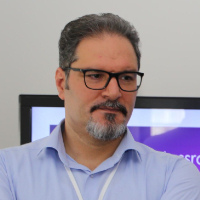
Jaber Kamali (from Ibn Haldun University, Istanbul, Türkiye) is the Editor-in-Chief of the Language Teacher Education Research Journal and TESOL Coordinator at IHU. He has published on various aspects of teacher education in international journals, including TESOL Quarterly, the European Journal of Teacher Education, Language Teaching Research, International Journal of Educational Technology in Higher Education, and International Journal of Multilingualism, among others, and also edited and is editing some edited collections and special issues such as the one on Technology-Enhanced Language Teacher Education in the Technology in Language Teaching & Learning journal. He was also among the top-cited authors of Wiley publications in 2020-2021. His latest publication, “Language as Power in Language Teacher Education Ecosystem,” is published in the Cambridge Elements series.
Sustainability as Cultural Work: An Evocative Autoethnographic Inquiry on Becoming an “Eco-Responsible” Teacher Educator
Abstract
This keynote presentation is an autoethnographic inquiry into what it means to become an “eco-responsible” teacher educator when sustainability enters educational life not as a neutral topic but as a culturally loaded and emotionally consequential demand. Rather than treating sustainability as content to be “added” to the curriculum, I approach it as cultural work: a lived process through which values, responsibilities, and relationships are continuously negotiated within specific institutional conditions. The keynote is organized around five evocative scenarios drawn from my professional practice as a language teacher educator and supported by pedagogical artifacts (slides, lesson plans, classroom tasks) and reflective memos. Scenario 1 begins with the “slide-deck panic”: preparing a sustainability session and recognizing the pressure to perform authoritative expertise, which prompts a shift from definitions to ethically framed inquiry. Scenario 2 follows an episode of student pushback in which sustainability is experienced as distant or privileged, leading to a reorientation toward locally meaningful “sustainabilities.” Scenario 3 confronts the feasibility wall (heavy workloads, standardization, and market-like expectations that turn sustainability into symbolic compliance), raising the question of what responsible practice can realistically be under constraint. Scenario 4 addresses eco-anxiety and emotional saturation in the classroom, where teaching sustainability becomes an exercise in holding fear, grief, and uncertainty without collapsing into catastrophe narratives or forced optimism. Scenario 5 examines unequal burdens of responsibility when sustainability is framed as an individual lifestyle choice, risking shame and exclusion for those with fewer resources. Across these episodes, eco-responsibility emerges not as a personal virtue but as a fragile stance sustained through care, accountability, and practical realism. The keynote concludes with a concise, reusable tool (an Eco-Responsibility Reflection Protocol) that teacher educators and researchers can apply to design sustainability learning that is culturally grounded, emotionally humane, and feasible without becoming performative. The keynote invites participants to reconsider sustainability education as a matter of becoming: not only what we teach, but who we are asked to be while teaching it.